
 Call Now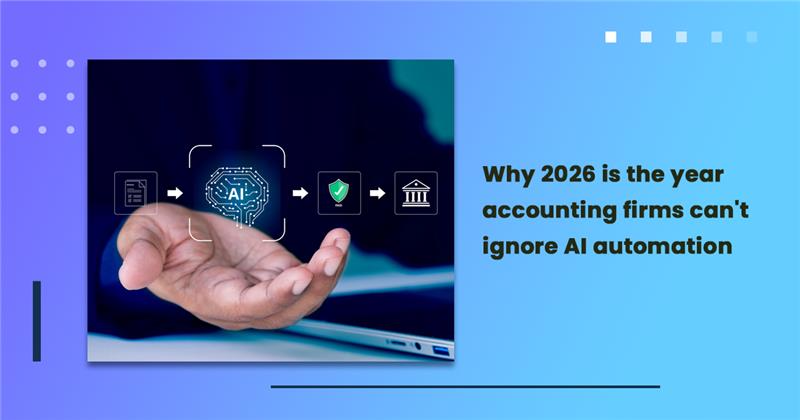
Why 2026 is the year accounting firms can't ignore AI automation
The accounting profession stands at an inflection point in 2026. What was once considered a futuristic luxury has rapidly become a competitive necessity. Accounting firms that embrace AI automation are not just surviving, they're thriving, expanding their client base, and transforming their service delivery models. Meanwhile, firms clinging to manual processes are finding themselves unable to compete on speed, accuracy, or profitability.
If you've been on the fence about AI bookkeeping automation, 2026 is the year to make your move. Here's why this moment in time is critical for your firm's future.
The shift from compliance to advisory is accelerating
According to recent industry surveys, 79% of accounting professionals expect significant growth in advisory services over the next few years. This isn't just wishful thinking, it's a reflection of changing client expectations. Modern business owners don't just want their books balanced; they want strategic insights, cash flow forecasting, and proactive financial guidance.
But here's the challenge: How can your team deliver high-value advisory services when they're buried in transaction categorization, bank reconciliations, and month-end close procedures?
This is where AI automation for accounting changes everything. By automating the time-consuming compliance work, AI frees your team to focus on what truly drives client value, and what clients are willing to pay premium fees for.
What does AI automation actually mean for your firm?
Let's get specific. AI automation in accounting isn't about replacing accountants, it's about eliminating the tedious, repetitive tasks that consume their time and drain their energy. Here's what modern AI bookkeeping platforms can handle:
Transaction Categorization: AI agents automatically review and categorize every bank and credit card transaction, learning from patterns and improving over time through machine learning.
Bank Reconciliation: Instead of manually matching transactions, AI handles reconciliation with precision, only flagging exceptions that need human attention.
Month-End Close: The entire closing process becomes automated, with AI and human accountants collaborating to ensure accuracy and speed.
Real-Time Updates: Books update daily or weekly instead of monthly, enabling you to offer advisory services based on current data rather than historical snapshots.
Error Detection: AI proactively catches duplicate vendors, missing information, and categorization errors before they become problems.
With Integra Balance AI's white-label bookkeeping platform, firms are cutting their bookkeeping hours by up to 91% while maintaining, or even improving, accuracy.
The numbers don't lie: Real ROI from AI adoption
The financial case for AI automation is compelling. Consider these real-world impacts:
Time Savings: Firms using AI automation report completing bookkeeping tasks 77% faster than manual methods. This translates to hundreds of billable hours freed up per month.
Cost Efficiency: An AI agent costs approximately 20-33% of a full-time employee, works 24/7 without vacations, and never quits. The payback period for most implementations is between 3-12 months.
Client Capacity: Multiple firms have reported adding 40% more clients without increasing headcount, simply by deploying AI to handle routine bookkeeping tasks.
Revenue Growth: By reallocating staff time to advisory services, firms are able to increase revenue per client while improving service quality.
As Jason, an Accounting Manager from Omaha, shared: "Since we started using Integra Balance AI, the extra time we spend communicating with our clients and chasing them has drastically reduced. This has helped us add more clients while keeping the same number of staff."
Why firms are spending $20,000+ on technology in 2026
The accounting technology landscape has evolved dramatically. Forward-thinking firms are investing heavily in their tech stack, averaging over $20,000 per year, because they recognize that technology is no longer an expense; it's a competitive advantage.
These investments typically include:
- AI-powered bookkeeping platforms with white-label capabilities.
- Automated bank reconciliation tools.
- Practice management systems with centralized status tracking.
- Client portals for seamless communication.
- AI OCR technology for document processing.
The firms making these investments aren't just buying software, they're buying scalability, competitive positioning, and the ability to deliver modern client experiences.
How do you know if your firm is ready?
Many firm owners wonder whether their practice is ready for AI automation. The good news? Most firms are more ready than they think. Consider taking an AI readiness assessment to evaluate your firm's current state.
Key indicators that you're ready include:
- Your team spends more than 20 hours per week on transaction categorization.
- You're turning away potential clients due to capacity constraints.
- Month-end close consistently takes longer than you'd like.
- Staff members express frustration with repetitive tasks.
- You want to transition toward advisory services but lack the bandwidth.
If any of these sound familiar, 2026 is your year to make a change.
What makes a white-label solution different?
Not all AI automation is created equal. White-label solutions offer a distinct advantage for accounting firms: the technology operates completely under your brand.
Your clients see your firm's name, logo, and URL. They have no idea that AI agents and a dedicated support team are working behind the scenes. This means you get all the benefits of cutting-edge technology while maintaining complete control over your client relationships and brand identity.
This is particularly important for firms looking to scale. As Elizabeth, a Senior Partner in Tampa, noted: "Our clients are delighted with our faster response and our staff is happier with the amount of time spent on end-of-month closing."
Starting small: The low-risk path to AI adoption
One common misconception is that AI adoption requires a massive, all-in commitment. In reality, the smartest firms start small, prove the value, and then expand.
You might begin by:
- Selecting 5-10 pilot clients with straightforward bookkeeping needs.
- Deploying QuickBooks AI or Xero AI for those specific accounts.
- Measuring time savings and accuracy improvements over 60-90 days.
- Gathering feedback from both staff and clients.
- Gradually rolling out to your entire client base.
This phased approach minimizes disruption while building internal confidence and expertise.
The competitive landscape is changing fast
Here's an uncomfortable truth: Your competitors are likely already exploring or implementing AI automation. Firms that adopt these technologies early are positioning themselves to win market share over the next several years.
Consider the math: If your competitor can handle 50% more clients with the same staff size, offer real-time reporting, and still deliver faster month-end closes, how long will it take before clients start asking why you can't do the same?
The window for being an "early adopter" is closing. By the end of 2026, AI-powered bookkeeping will likely be table stakes rather than a differentiator.
People Also Ask
Q1. Is AI going to replace accountants in 2026? A1. No, AI is not replacing accountants, it's eliminating the manual, repetitive tasks that accountants have traditionally had to perform. This allows accounting professionals to focus on higher-value activities like strategic advisory, financial planning, and client relationship management. Think of AI as a tool that enhances accountant capabilities rather than replacing them. Firms using AI bookkeeping automation report that their staff members are happier and more engaged because they're doing more intellectually stimulating work.
Q2. How much does AI accounting automation cost in 2026? A2. The cost varies depending on your firm's size and needs, but it's more affordable than most people expect. Integra Balance AI offers plans starting at $55 per client per month for full AI-driven bookkeeping, which includes automated categorization, reconciliation, and month-end close. Most firms see payback within 3 months.
Q3. What accounting tasks can be automated with AI? A3. Modern AI platforms can automate a wide range of accounting tasks including: transaction categorization, bank reconciliation, credit card reconciliation, invoice data extraction through OCR, receipt processing, journal entries, payroll categorization, month-end closing, error detection, and financial reporting.
Q4. How long does it take to implement AI bookkeeping? A4. Implementation timelines vary based on complexity, but most firms can start seeing results within 3 to 5 days weeks for straightforward bookkeeping automation. For more complex, custom workflows, implementation might take 3 weeks. The key is starting with a pilot program, selecting a handful of clients, testing the system, and gradually expanding. This phased approach minimizes disruption and allows your team to build confidence with the technology. Many firms complete their full rollout within 90 days.
Q5. Is AI bookkeeping accurate and secure? A5. Yes, when implemented properly. Modern AI bookkeeping platforms achieve 97-99% accuracy rates, which often exceeds manual processing. Integra Balance AI uses a multi-level verification approach: AI handles initial categorization, and human accountants review exceptions and complex transactions. For security, look for platforms with ISO 27001 certification (similar to SOC 2), bank-grade encryption, and compliance with international data privacy standards.
Take the First Step Toward AI Automation
2026 presents a unique opportunity for accounting firms. The technology has matured, the pricing has become accessible, and the competitive advantages are undeniable. The question isn't whether to adopt AI automation, it's whether you want to be among the leaders or the laggards.
Ready to see what AI can do for your firm? Schedule a demo with us to see our AI automation in action. Discover how firms like yours are cutting bookkeeping hours by 91%, adding more clients without hiring more staff, and positioning themselves as modern, forward-thinking practices.
The future of accounting is here. Make 2026 the year your firm embraces it.
Schedule Your Free Demo
With our accounting automation experts
Find out how other practices have benefited using Integra Balance AI bookkeeping automation. 87% of practices who viewed AI bots in action have instantly discovered the advantages of using them at their firm.
Global Offices
US (Head Quarters)
Integra Global Solutions Corp
7500 Brooktree Road, Suite 100
Wexford (Pittsburgh)
PA 15090
+1 412 267 1529
Philippines
Integra Global Solutions Corp
Ayala Cebu Tower,
Cebu Business park, Cebu 6000
+1 412 267 1529
Europe
Integra Global Solutions UK Ltd
College House
17 King Edwards Road
Ruislip, London, UK, HA4 7AE
+44 (0)20 7993 2949
Canada
Integra Global Solutions Corp
32 Blencathra Hill, Unit 100, Markham
Ontario
+1 412 267 1529
India
Integra Global Solutions Corp
First floor, Kanapathy Towers,
Opp.BSNL exchange, Ganapathy,
Coimbatore – 641 006, India
+91 (0422) 437 9555
Australia
Integra Global Solutions Corp
+61 02 8005 1836